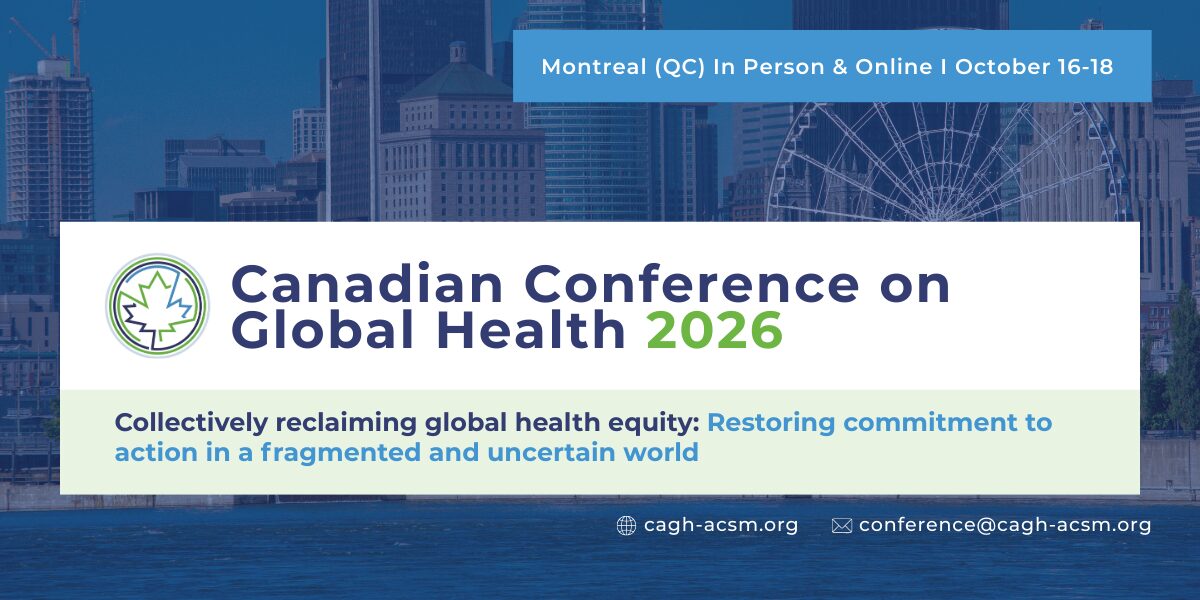
From October 16 to 18, 2026, the Canadian Conference on Global Health (CCGH) will bring together global health stakeholders in Montréal around a theme that is particularly relevant in the current context: Collectively reclaiming global health equity: Restoring commitment to action in a fragmented and uncertain world.
Just days before this major event, the Unité de santé internationale (USI) reflects on what it means, in practical terms, to collectively reclaim global health equity.
A Changing context that calls for rethinking how we act
Fragmented global health governance, declining resources, multiplying crises, and growing pressure on health systems: the CCGH 2026 highlights the profound challenges facing an increasingly fragile world. Efforts to improve access to healthcare and reduce inequalities must take into account power dynamics, the priorities of affected populations, the capacities of existing systems, and the specific realities of different intervention contexts.
Reclaiming equity also means questioning how projects are designed, governed, and implemented, as well as the role given to the institutions, communities, and partners involved. One of the approaches prioritized by the USI is to strengthen existing systems to foster sustainable change. To this end, the USI works closely with ministries, healthcare institutions, universities, civil society organizations, and communities, building on existing capacities and taking local priorities into account.
Co-creation is also central to this approach. Solutions are better adapted to local realities when they are developed with those who understand these realities and will be directly involved in implementation. This approach also fosters greater engagement and ownership.
Finally, advancing equity requires recognizing and integrating different forms of knowledge, including scientific evidence, professional expertise, lived experience, and local knowledge.
“Through global health practice and research evidence, we know that the most promising interventions are not those designed for communities based solely on our own expertise, but those developed with the people directly concerned. These partners are very real: health authorities, healthcare professionals, education and research institutions, local organizations, and communities in all their diversity. Co-creation requires time, active listening, humility, and recognition that these stakeholders possess irreplaceable expertise regarding their own realities, constraints, and priorities. Partnerships then become spaces for mutual learning, where everyone contributes and grows. This reciprocity fosters more equitable, respectful, and transformative collaboration, helping to strengthen resilient health systems and communities that are better equipped to respond to health crises. This is precisely what we are experiencing with our partners in eastern Democratic Republic of the Congo through the TUMAINI project, where adaptability, informed by local knowledge, is essential to addressing the consequences of armed conflict, including population displacement and supply chain disruptions, as well as challenging climatic conditions.” André-Paul Vénor, Senior Coordinator, USI.
Building Resilient Health Systems
This approach is particularly important when health systems face political, economic, health, or climate-related crises. Resilience is not simply about maintaining healthcare services; it also means ensuring that these services remain accessible and of high quality, particularly for the most vulnerable populations.
This is one of the key challenges addressed by the Ma santé, mes droits / Sante mwen, dwa mwen / Mi Salud, Mis Derechos project, implemented in Colombia, Guatemala, and Haiti. This seven-year initiative, implemented by the USI, Avocats sans frontières Canada, and CECI, aims to improve access to sexual and reproductive health services and rights, particularly for women, adolescent girls, and people in vulnerable situations. The project receives financial support from the Government of Canada through Global Affairs Canada.
At CCGH 2026, Marie Dorey, Monitoring and Evaluation Officer for the Ma santé, mes droits project at the USI, will explore this approach in her oral presentation, titled “Strengthening the Resilience, Equity, and Gender Responsiveness of Sexual and Reproductive Health Systems: An Approach from a Multi-Country Project in Colombia, Guatemala, and Haiti.
“Colombia, Guatemala, and Haiti face common sexual and reproductive health challenges, including high maternal mortality, adolescent pregnancies, and gender-based violence, despite their very different contexts. The challenge is to implement a project structured around a shared theory of change without splitting it into three separate projects or imposing a uniform model that would fail to meet the needs of the populations. Monitoring and evaluation are essential to maintaining this balance. In accordance with the results-based management approach required by Global Affairs Canada, they make it possible to adjust activities to the actual needs of the populations. The project’s ability to adapt is itself an illustration of this resilience. In Colombia, for example, baseline data collection was postponed following the earthquake that affected the regions where the project operates. The consortium’s holistic approach, which integrates health, community, and rights-based components, aims to promote more equitable enjoyment of sexual and reproductive health and rights among women, adolescent girls, and children, particularly those experiencing vulnerability or marginalization.” Marie Dorey, Monitoring and Evaluation Officer, Ma santé, mes droits Project, USI.
Generating knowledge is not enough: we must create the conditions for its use
The third subtheme of CCGH 2026, “From Evidence to Impact,” raises another fundamental question: how can we ensure that the knowledge generated actually leads to concrete action? This question lies at the heart of the USI’s academic foundations. Affiliated with the School of Public Health at Université de Montréal, the USI operates at the intersection of research, education, and field-based interventions.
This academic affiliation enables the USI to mobilize scientific expertise, generate and analyze project data, support monitoring and evaluation, and facilitate knowledge transfer.
“Researchers excel at generating new knowledge and producing evidence; practitioners at implementing interventions within communities; and policymakers at adopting, or choosing not to adopt, policies and standards according to their own timelines. Bridging the gap between evidence and action therefore requires a carefully tailored strategy, grounded in local contexts and community realities, while identifying the enabling conditions needed to seize political and social windows of opportunity. Understanding how to translate evidence into action to reduce social inequities in global health is one of the central objectives of CCGH in Montréal.” Muriel Mac-Seing, Co-Chair of CCGH 2026, Assistant Professor at the School of Public Health, and Associate Researcher at the USI, Université de Montréal.
Reclaiming Equity Together
At a time when resources are becoming increasingly scarce and needs continue to grow, no university, government, international development organization, or community-based organization can address global health challenges alone. Advancing equity requires bringing together knowledge, experience, and capacities for action, while building partnerships in which responsibilities, learning, and decision-making are more equitably shared.
It is in this spirit that the USI will participate in CCGH 2026: to share lessons learned from its interventions, learn from the experiences of others, and contribute to a collective reflection on how to turn commitments to equity into concrete and lasting change.