
Mobile clinic in the Grand-Pré area. Photo credit: USI.
As part of the Quebec government’s "Engaged for Haiti" program, implemented through the 2023–2026 Haiti Support Plan, the Unité de santé internationale (USI) has received funding of $500,000 CAD via the Ministry of Health and Social Services (MSSS) to carry out three sub-projects over a three-year period.
This initiative builds on long-standing collaborations with Haiti’s Ministry of Public Health and Population (MSPP) and aims to support decentralized health structures in the North of the country. Haiti continues to face a prolonged socio-political and security crisis, making it increasingly difficult to maintain essential services, including primary health care, across most regions. This situation, compounded by high inflation and ongoing fuel shortages, has severely disrupted transportation and supply chains for medicines and other health products.
1. Supporting Primary Health Care Access for Vulnerable Groups in Northern Haiti
Implemented in partnership with the MSPP, this sub-project seeks to sustain and strengthen primary health care delivery in communities, particularly amid the country's mounting challenges. First, the initiative improves geographic access to health services through mobile clinics that reach the most vulnerable populations in remote areas. Second, it raises awareness about available health services, with a focus on sexual and reproductive health and rights (SRHR).
With financial support from the MSSS, USI is helping the Northern Health Department (DSN) restock essential medicines and supplies in three communes: Bahon, Bord-de-Mer de Limonade, and Grand-Pré. USI also supports the organization of mobile clinics, community mobilization efforts, and SRHR education workshops.
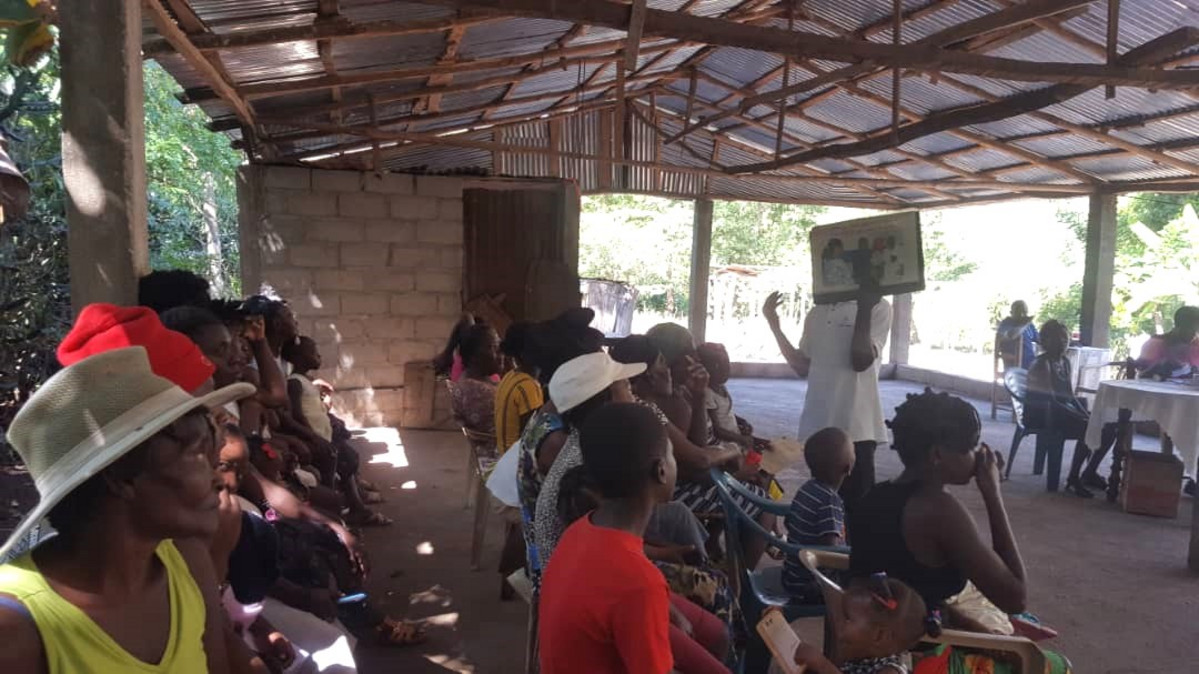
Awareness workshop. Photo credit: Marie Landy Sanon.
Departmental health officials highlight that this initiative goes beyond medical consultations, by contributing to the relaunch of vaccination campaigns in these areas. Ultimately, the project aims to secure and expand access to quality primary health care for the most vulnerable populations—especially women, adolescent girls, and children in the North and Northeast departments—with additional support from Global Affairs Canada.
2. Visual Health for All
In collaboration with the School of Optometry of the Faculty of Medicine and Pharmacy of the State University of Haiti (EOH), the School of Optometry of the Université de Montréal (ÉOUM), the Brien Holden Foundation (BHF), and Optometry Giving Sight (OGS), this sub-project covers the internship costs of final-year optometry students. Between July and December 2024, five students completed six-week internships at the Cathy Pearson & Fortune Previl Memorial Clinic in Quartier Morin, Northern Haiti. Around 20 students are expected to complete placements. These internships directly contribute to improving access to quality visual health care services in the country.

Two interns at the Cathy Pearson & Fortune Previl Memorial Clinic. Photo credit: USI.
3. Strengthening Emergency Response Capacity for a Resilient Health System
This sub-project aims to reinforce crisis management training for Haitian health managers. Training is provided in collaboration with the School of Public Health of the Université de Montréal (ESPUM), the Faculty of Medicine and Pharmacy of the State University of Haiti (FMP/UEH), the DESS program in Health Systems Management (MGSS), and the National Unit for Health Emergency Management (UNGUS) of the MSPP. Activities are set to begin soon.
Since 1989, USI has led over 19 intervention projects in collaboration with the MSPP and other partners, building on a vast network of trained health managers.