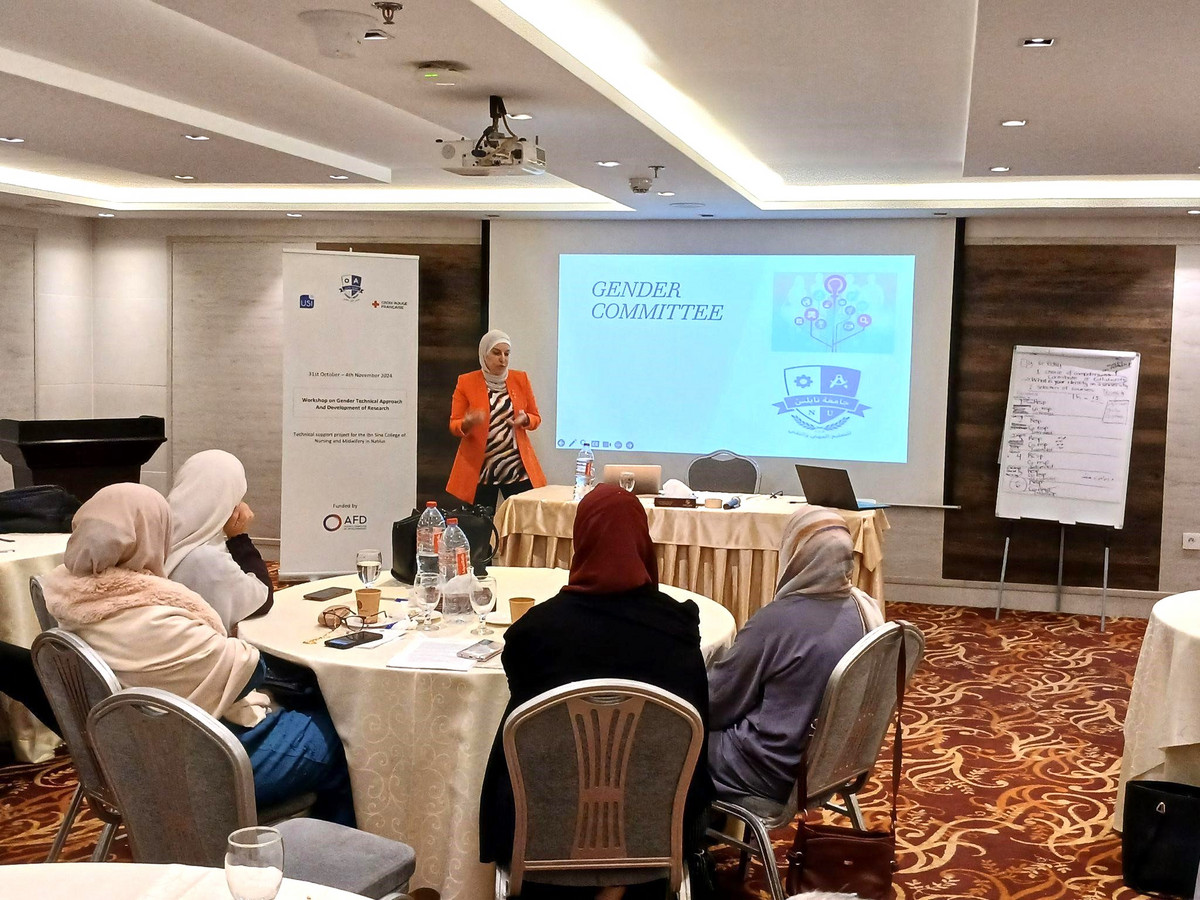
 Photo credit: French Red Cross
A Commitment to Gender Equality and Improved Health Care in the West Bank
The Support for the Development of the Ibn Sina College (ISC) School of Nursing and Midwifery in Nablus project is a five-year initiative funded by the French Development Agency (AFD). It is implemented by the French Red Cross in partnership with the Palestinian Red Crescent Society and the Université de Montréal (via the Unité de santé internationale and the Faculty of Nursing). ISC, part of the Nablus University for Vocational and Technical Education, is one of the few public nursing and midwifery schools in the West Bank. The project aims to improve the quality of care in the region by modernizing ISC’s educational offerings, upgrading its equipment, and enhancing its operations as a training and research center.
USI, in collaboration with the Faculty of Nursing, contributes its expertise in health training and research, particularly in nursing science. It also supports the development of innovative teaching modules and the organization of participatory workshops to build the teaching staff’s capacity.
A Key Role in Mainstreaming Gender in Education and Research
Within the project, USI plays a central role in integrating gender considerations into the training of future health professionals. A distinctive aspect of the initiative is its cross-cutting approach to gender equality, which is embedded throughout the development process of ISC. This is reflected in the three components of ISC’s Gender Action Plan:
1. Ensuring that the design and construction of ISC’s new infrastructure incorporates gender considerations, based on consultations with students and staff to identify their specific needs;
2. Strengthening gender equality in ISC governance, aligning it with the gender equality goals of the Palestinian Ministries of Health and Higher Education and Scientific Research, and internationally recognized best practices;
3. Integrating gender equality into ISC’s curriculum and empowering students to promote gender equality in their future practice as nurses and midwives.
As part of the third component, a participatory workshop was held in Amman, Jordan, in October 2024, bringing together ISC’s faculty and leadership. To support the integration of sex and gender in education and research, ISC’s Gender Advisory Committee identified four key thematic modules:
1. Mainstreaming gender in curricula
2. Mainstreaming of gender issues in research
3. Gender equality in the workplace
4. Gender-based health equity
These modules are being developed throughout the project by Marie Jobin-Gélinas (Gender and Human Rights Advisor at USI), Marie-Douce Primeau (Development, Monitoring and Evaluation Lead at USI), and Bilkis Vissandjée (Full Professor at the Université de Montréal’s Faculty of Nursing), who each bring complementary expertise in gender, pedagogy, and research.
The integration of these modules will equip future nurses and midwives to better promote gender equality in their professional practice. The modules are a direct response to a gender analysis conducted at the start of the project, which identified a need to strengthen faculty knowledge and skills regarding sex and gender as social determinants of health. Designed as practical, evidence-based, and contextually relevant tools, the modules will be available to ISC faculty for use across various nursing courses.
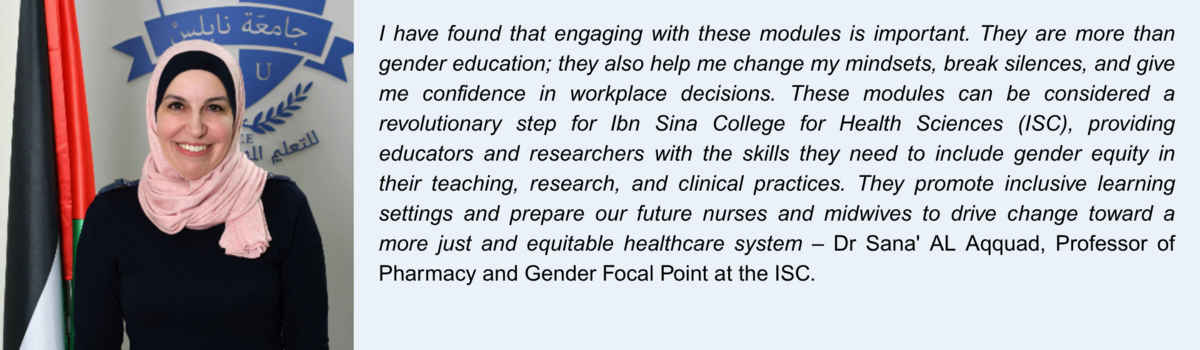
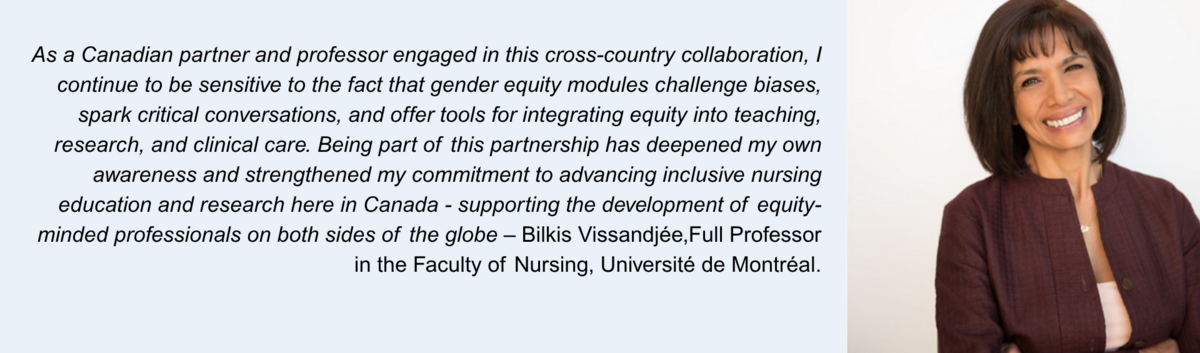
This project emphasizes the importance of raising awareness among health professionals about gender issues and providing them with the tools to deliver context-sensitive, evidence-based education. By doing so, it contributes to the development of a more equitable, inclusive, and just health system.
A five-year framework agreement has also been signed between the Université de Montréal and Nablus University to facilitate student and faculty exchanges and foster the development of joint research and cooperation initiatives.